
A city that looks complete… is it?
From a distance, Mumbai feels complete. Glass towers rise into the sky, roads stretch with purpose, and the city moves with a quiet confidence. It looks as though progress has found its place.
But move a little closer, and something begins to shift.
Not everything grows at the same pace, and not everything reflects the same story. There are parts of the city where time does not move backward, nor fully forward, but seems to exist somewhere in between.
Where does the city change its rhythm?
Dharavi is one such place.
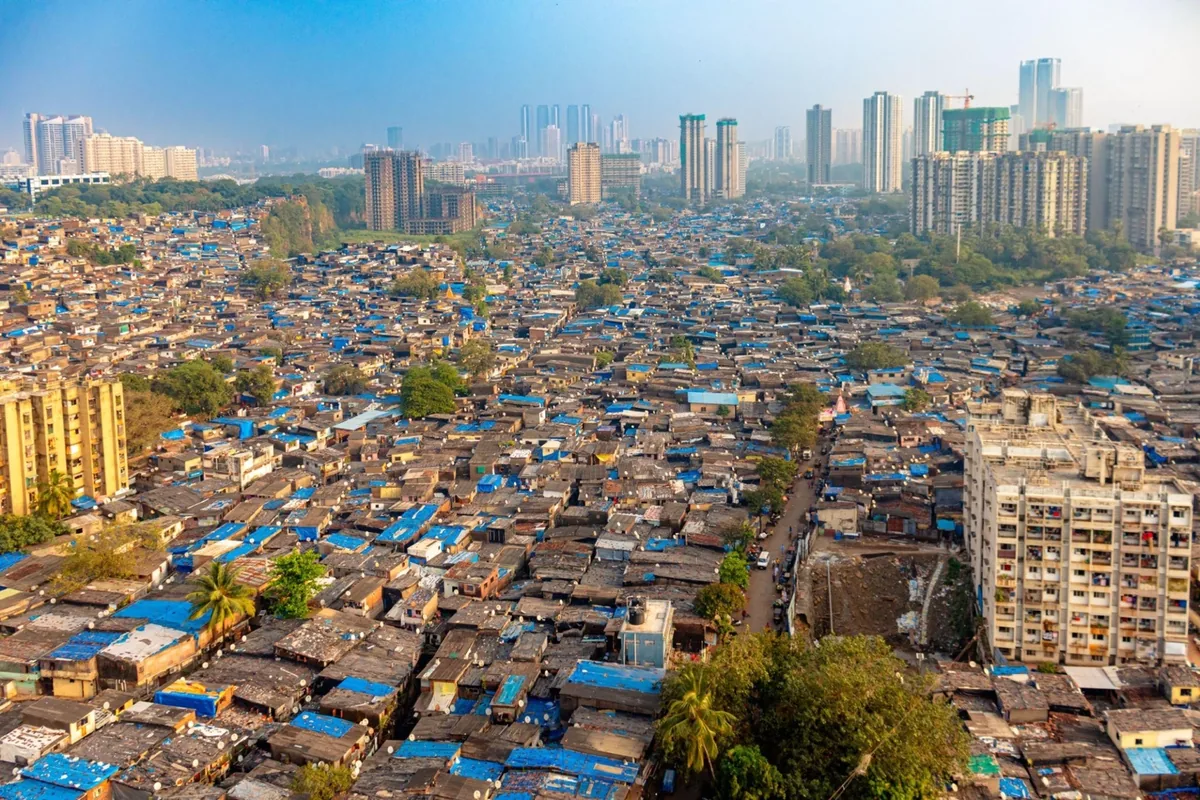
The idea of Dharavi Mumbai inequality becomes visible when seen against the city’s skyline. Set against the backdrop of Mumbai’s expanding skyline, Dharavi does not sit outside the city; it lives within it. For many first-time observers, the contrast feels immediate, almost unsettling. Travel voices, including Santhosh George Kulangara, have often reflected on how this contrast shapes one’s first impression — admiration for the city’s ambition, and a quiet pause at what lies beneath it.
At first glance, the question feels simple:
How can two realities exist so close, yet feel so far apart?
Is what we see the full picture?
From above, the difference is visible. On one side, structures rise with order and design; on the other, a dense network of homes, pathways, and lives built layer by layer.
Yet what appears disorganised from a distance often carries its own structure within.
Dharavi is not just a space; it is a system. Homes and workplaces exist side by side, small industries function within narrow lanes, and daily life and livelihood remain closely intertwined. What looks informal from the outside is, for many, a carefully balanced way of living.
What does change really mean here?
Over the years, proposals have been made to transform this space by offering improved housing, better sanitation, and a more organised environment. On paper, the idea feels complete — comfort on one side and structure on the other.
Yet the reality is far more complex.
Change, in such a place, is not only about buildings; it is about movement — of people, routines, relationships, and trust. For some, redevelopment represents opportunity, while for others it introduces uncertainty.
From the outside, hesitation may appear as resistance.
From within, it may feel like risk.
What do we choose to preserve?
Somewhere within this complexity, another thought begins to form.
In distant parts of the world, deep within the Amazon, there are communities that continue to live within their own ecosystems — shaped by nature, sustained by routine, and largely untouched by modern systems. These spaces are protected, not only for the people who live there, but for what they represent: continuity, balance, and a way of life that has not been replaced.
And then there is Dharavi.
It is not hidden, not untouched, and not protected in the same way. It exists in the centre of movement — within commerce, growth, and constant change. It produces, adapts, and survives — an ecosystem, not of forests, but of people.
And that is what makes the contrast harder to define.
Is growth the same for everyone?
The city continues to rise, and its skyline grows without hesitation. Yet beneath that growth, there remains a layer that does not fully align with it — not absent, not invisible, but present in a different form.
Perhaps progress is not only about how far a city moves forward, but how evenly that movement is shared.
When better housing, comfort, and structure are offered on one side, and another way of living continues on the other, the question is no longer just about development.
It becomes a question of balance.
So, what truly defines progress?
Mumbai does not hide this contrast. It carries it — in its centre, in its rhythm, and in its everyday life.
A city can grow taller.
It can expand faster.
But what it chooses to preserve might define what it truly becomes.
So the question is not just whether Dharavi should change, but what, within it, is worth keeping… and why?